Leading Potato Frozen Food Products Manufacturer
16 April, 2024
The global food industry is witnessing a strong shift toward convenience-based eating, and frozen potato products are at the center of this transformation. As international demand for ready-to-cook foods continues to rise, export opportunities are expanding rapidly across food service, retail, and bulk supply segments. By 2026, frozen potato products are expected to play a crucial role in global food trade due to their versatility, shelf life, and consistent quality. For manufacturers and exporters, this creates a timely opportunity to scale operations and enter high-growth markets with confidence.
This guide explores key markets, product categories, and export strategies shaping frozen potato trade in 2026.

The frozen food sector has grown steadily over the past decade, with potato-based items maintaining a dominant share. Urban lifestyles, increased working populations, and the expansion of quick-service restaurants have significantly influenced consumption patterns.
By 2026, demand for frozen potato products is projected to grow across both developed and emerging economies. Countries with limited agricultural output but strong food service industries are increasingly dependent on imports. This trend positions export-oriented suppliers to benefit from long-term, volume-driven demand.
Growing preference for convenience and ready-to-cook foods
Expansion of global QSR and casual dining chains
Increased demand from hotels, caterers, and institutional buyers
Improved cold-chain infrastructure in developing regions
These factors collectively make frozen potato exports a stable and scalable business opportunity.
Frozen potato products are ideal for export due to long shelf life, consistent quality, and compatibility with global cold-chain logistics. Export success depends heavily on product stability, transport efficiency, and market acceptance. These products meet all these requirements, making them highly suitable for international trade.
They offer a longer shelf life compared to fresh alternatives, reducing spoilage risks during transit. Standardized processing ensures uniform taste and texture across batches, which is critical for food service buyers. Additionally, potato-based products enjoy global culinary acceptance, allowing exporters to target diverse markets without major product modifications.
Easy storage and handling under frozen conditions
Minimal preparation time for end users
Consistent quality across large-volume shipments
Strong demand from food service and HoReCa sectors
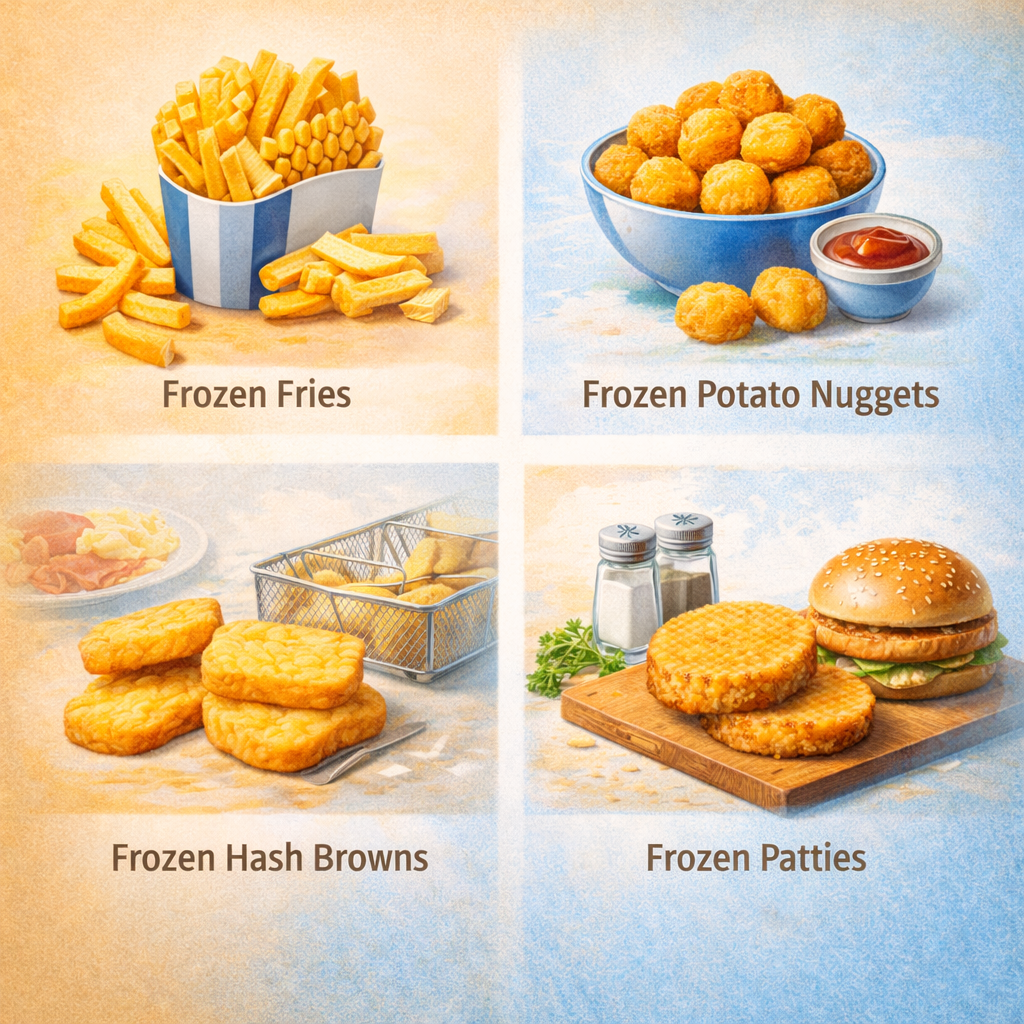
Different international markets show varying preferences when it comes to potato-based offerings. Exporters that understand product-level demand gain a competitive edge.
Frozen fries remain the most widely consumed potato product worldwide. They are a staple across fast food outlets, restaurants, and catering services. Various cut styles and coating options make them adaptable to regional tastes, increasing their export appeal.
Frozen potato nuggets have gained popularity due to their snack-friendly format and broad consumer appeal. They are widely used in quick-service menus and institutional catering, particularly in emerging markets where western-style snacks are growing rapidly.
Frozen hash browns are especially popular in breakfast menus across hotels and food chains. Their consistent portioning and ease of preparation make them a preferred choice for bulk buyers and international distributors.
Frozen patties offer versatility in usage, from burgers to plated meals. Their structured form and customizable seasoning options make them suitable for both food service and private-label export programs.

Export growth is not evenly distributed across regions. Understanding market maturity and entry barriers is essential for strategic expansion.
Middle East & GCC: Strong dependence on imports and high food service demand
Southeast Asia: Rapid urbanization and expanding QSR presence
Africa: Growing middle-class consumption and limited local processing
Europe: Consistent demand for standardized frozen foods
North America: Import demand in niche and private-label segments
Each region presents unique opportunities based on consumption habits and supply gaps.
Compliance plays a critical role in international food trade. Exporters must meet destination-specific regulations to ensure smooth market entry.
Food safety and hygiene certifications
Packaging and labeling compliance as per local laws
Shelf-life validation and cold storage documentation
Meeting these requirements not only ensures regulatory approval but also builds trust with global buyers.
A reliable frozen potato products manufacturer forms the backbone of any export operation. Manufacturing consistency, scalable capacity, and adherence to international standards directly influence buyer confidence.
Export-focused manufacturers invest in standardized processing, quality control systems, and product testing. This ensures uniform output regardless of order volume, which is essential for long-term contracts and repeat buyers.
A dependable frozen potato products supplier offers more than just product availability. Timely delivery, flexible packaging options, and logistical coordination are equally important.
Suppliers that understand export documentation, cold-chain requirements, and bulk handling help importers reduce operational risks. Long-term supplier relationships often lead to stable pricing and predictable supply cycles.
A successful frozen potato products exporter combines market knowledge with operational efficiency. Exporters must understand regional demand patterns, pricing sensitivities, and distribution channels.
Strong exporter networks enable access to distributors, food service buyers, and private-label clients. Effective coordination between production, logistics, and compliance teams ensures consistent delivery performance.
Export pricing is influenced by raw material costs, processing efficiency, packaging, and freight charges. Maintaining profitability requires careful planning and market-specific pricing strategies.
Cold-chain logistics play a crucial role in preserving product quality during transit. Exporters must work with experienced logistics partners to manage temperature control, lead times, and port handling. For any frozen potato products exporter, efficient cold-chain management is essential to ensure consistent quality and buyer confidence in international markets.
Bulk and volume-based pricing models
Private-label and contract manufacturing arrangements
Freight optimization and long-term shipping contracts
|
Region |
Demand Level |
Popular Product |
Entry Complexity |
Growth Potential |
|
Middle East |
High |
Frozen fries |
Medium |
Very High |
|
Southeast Asia |
High |
Potato nuggets |
Medium |
High |
|
Africa |
Medium |
Patties |
Low |
High |
|
Europe |
High |
Hash browns |
High |
Medium |
|
North America |
Medium |
Fries |
High |
Medium |
Preparation is key to capitalizing on export opportunities. Businesses should focus on capacity planning, quality consistency, and export readiness well in advance.
Investing in process optimization, supplier partnerships, and market research enables smoother scaling. Export-oriented planning also reduces last-minute compliance and logistics challenges.
Customization enhances competitiveness in global markets. Tailored cuts, coatings, and packaging sizes allow exporters to align products with regional preferences and private-label requirements.
Chillfill Foods focuses on export-ready frozen potato products with consistent quality, scalable capacity, and compliance-driven processes. As a trusted frozen potato products exporter, the company supplies ready-to-cook solutions for food service, bulk buyers, and international markets. With a product portfolio aligned to global demand trends, Chillfill Foods supports growing import needs across regions. Its manufacturing capabilities and export-focused approach make it a reliable partner for distributors and institutional buyers. As global demand rises in 2026, Chillfill Foods is well-positioned to support sustainable export growth.
The frozen food industry is evolving beyond convenience. Clean-label formulations, reduced additives, and sustainable packaging are gaining importance among global buyers. By 2026, private-label sourcing is also expanding, creating new opportunities for export-oriented manufacturers.
These trends will shape how exporters position their offerings in competitive international markets.
Export opportunities for frozen potato products in 2026 are driven by strong global demand, evolving food service needs, and improved cold-chain infrastructure. Businesses that focus on quality, compliance, and market-specific strategies are well positioned to succeed. By aligning production capabilities with export requirements, manufacturers and exporters can achieve sustainable growth in the international frozen food landscape.
Frozen fries lead exports, followed by nuggets, hash browns, and patties due to high food service demand.
Food safety, hygiene, packaging, and labeling certifications are commonly required depending on the destination market.
With proper cold storage, most products maintain quality for several months under recommended conditions.
The Middle East, Southeast Asia, and Africa show strong growth potential due to rising import dependence.
Yes, they are widely exported for food service and institutional use due to ease of handling and preparation.