
Leading Potato Frozen Food Products Manufacturer
16 April, 2024

Key Takeaways
The quality of frozen french fries begins long before the potato reaches the processing plant. One of the most important decisions in frozen fry production is selecting the right potato variety. The variety determines key quality factors such as texture, color, crispiness, oil absorption, yield, and shelf life.
For frozen food manufacturers, QSR chains, HoReCa suppliers, and food importers, choosing the right processing-grade potato variety is essential for maintaining consistent product quality and reducing production losses.
Not every potato is suitable for frozen french fries. Processing potatoes are specially selected for their chemical composition, shape, starch structure, and storage performance.
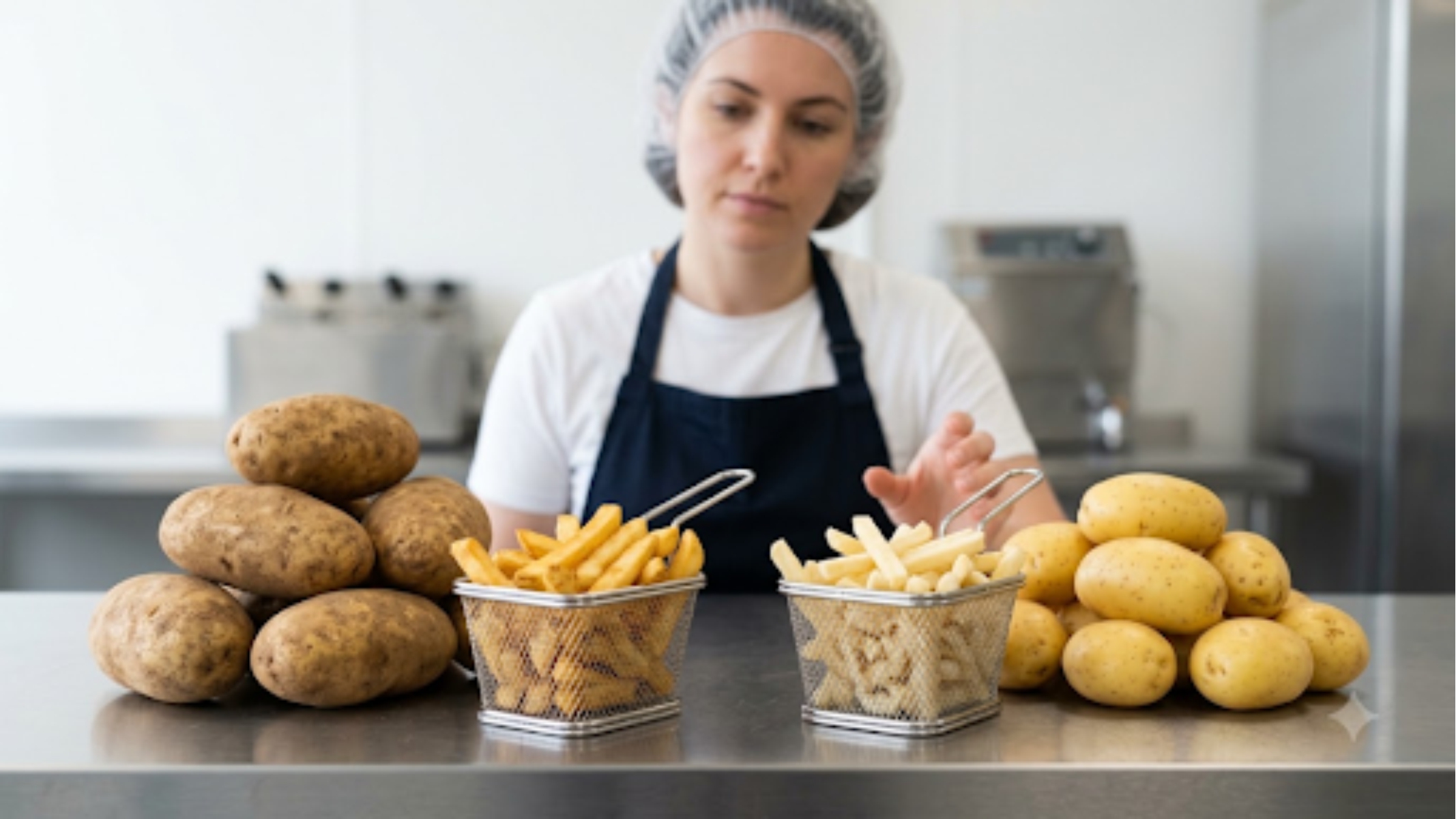
A high-quality french fry potato must meet specific requirements that table potatoes usually do not provide. The most important characteristics include:
Dry matter refers to the solid content of a potato after removing moisture. Ideal french fry potatoes typically contain 20-25% dry matter.
Higher dry matter provides:
Potatoes with low dry matter contain more water, which creates soft, greasy, and less appealing fries.
Reducing sugars strongly influence fry color. During frying, sugars react with amino acids through the Maillard reaction, causing browning.
For commercial frozen fries, reducing sugar levels should generally remain below 0.1%. High sugar content results in:
Proper variety selection and storage conditions help maintain low sugar levels.
Starch plays a major role in creating the classic french fry texture. High-starch potatoes produce fries with a crispy outer layer and soft, fluffy interior.
Low-starch or waxy varieties often create dense, gummy fries that do not meet commercial quality standards.
Potato variety affects every stage of production, from cutting to freezing.
The right variety creates the ideal balance between a crispy exterior and fluffy center. High dry matter potatoes form a strong structure during frying, allowing fries to remain crisp even after reheating.
This is especially important for restaurants and QSR chains where product consistency directly affects customer satisfaction.
Consumers expect frozen french fries to have a uniform golden color. Varieties with high reducing sugar levels produce darker fries and inconsistent batches.
Processing varieties are selected because they maintain stable sugar levels and deliver predictable frying results.
The starch structure and moisture content of a potato variety influence frozen storage performance. Suitable varieties resist texture damage caused by freezing and reduce problems such as excessive ice crystal formation.
This makes them better suited for export markets and long-distance frozen supply chains.
The quality of frozen french fries depends on selecting potatoes with the right processing characteristics. According to PotatoPro, factors such as dry matter, starch content, reducing sugars, and potato shape play a key role in achieving crispy texture, golden color, efficient processing, and consistent product quality.
|
Characteristic |
Ideal Requirement |
Importance |
|
Dry matter |
20–25% |
Improves crispiness and reduces oil absorption |
|
Reducing sugars |
Less than 0.1% |
Maintains golden fry color |
|
Starch content |
High |
Creates fluffy internal texture |
|
Specific gravity |
1.080–1.110 |
Indicates dry matter level |
|
Shape |
Long and oval |
Produces longer, uniform fries |
|
Skin |
Smooth and thin |
Reduces peeling losses |
Several potato varieties are widely used by commercial processors because of their excellent processing performance.
Russet Burbank is considered one of the global benchmarks for frozen french fries. It offers:
Its consistent quality makes it popular among large-scale processors and QSR suppliers.
Shepody is valued for its reliable performance and early maturity. It is suitable for regions with shorter growing seasons and provides good processing quality.
Innovator is known for high yield, good shape, and strong storage performance. It performs well across different growing conditions.
Popular in European processing markets, Markies provides high dry matter, excellent fry color, and long fry length.
Fontane is preferred for its high specific gravity, low sugar levels, and ability to produce light-colored fries with reduced oil uptake.
Developed for Indian growing conditions, Kufri Frysona offers high dry matter content and low reducing sugars, making it suitable for South Asian frozen fry production.
Long and uniform potato varieties create better fry lengths and reduce waste. Irregular-shaped potatoes produce more trimming losses and lower production efficiency.
Blanching controls enzymes and prepares potatoes for frying. Varieties with consistent starch properties respond better to blanching conditions, improving production reliability.
Before frying, moisture must be removed from potato strips. High dry matter varieties require less moisture removal, reducing energy consumption and improving processing speed.
Frying is where variety differences become most visible. Low-sugar varieties produce better color, while high-starch varieties create a stronger crispy crust and better internal texture.
Individual Quick Freezing preserves the structure of fries. Potatoes with stable cell structures freeze more effectively and maintain quality during storage and transportation.
Firm, high-quality varieties reduce breakage during handling and packaging. This improves product appearance and reduces losses from broken pieces.
Using unsuitable potatoes can create several quality issues:
|
Problem |
Main Cause |
|
Dark fries |
High reducing sugar levels |
|
Soft texture |
Low dry matter content |
|
Excess oil absorption |
Low starch structure |
|
Short fry length |
Poor potato shape |
|
Gummy interior |
Uneven starch distribution |
|
Poor frozen stability |
High moisture content |
Although table potatoes can be used for home cooking, they are not suitable for industrial frozen french fry production. Their lower dry matter, irregular shape, and higher sugar levels create inconsistent results.
Frozen food manufacturers can improve quality consistency by following these practices:
Controlled sourcing helps reduce quality variation and ensures consistent finished products.
For frozen food companies, potato variety selection is not only a technical decision but also a commercial one. The right variety improves production efficiency, reduces waste, and ensures that customers receive the same quality in every batch.
Export markets especially require fries that maintain texture, color, and taste during frozen storage and transportation. Suppliers who use processing-grade varieties and controlled supply chains can deliver more reliable products.
ChillFill Foods focuses on sourcing suitable processing-grade potatoes for frozen french fry production, supporting consistent quality for global buyers, importers, and food service partners.
Russet Burbank is widely recognized as a leading variety because of its high dry matter, low sugar levels, and excellent fry quality. Other popular options include Markies, Fontane, Shepody, and Innovator.
High dry matter reduces moisture content, resulting in crispier fries, lower oil absorption, and better texture after frying and freezing.
High reducing sugar levels cause dark browning during frying. Processing varieties are selected to maintain low sugar levels and achieve consistent golden color.
Table potatoes are not recommended for commercial production because they usually have lower dry matter, higher sugars, and irregular shapes.
Manufacturers evaluate dry matter, sugar levels, starch content, specific gravity, shape, yield, and storage performance before selecting varieties for processing.